Teuk Chhou is a local picnic and swimming spot about 8–9 km north of Kampot, where the river runs over rocks in a string of small cascades and pools. Families rent bamboo huts on stilts along the bank for a dollar or two, food sellers set up nearby, and foreigners are usually asked for an informal entry fee of about $1–2. Don't expect white water: a hydropower dam upstream controls the flow, and in the dry season the "rapids" are gentle. Go for a lazy swim and a long lunch, ideally on a weekday.
On this page
What Teuk Chhou actually is
You'll see it spelled Teuk Chhou, Tuek Chhu or Tek Chhou, and Cambodian tourism sites call it "Teuk Chhu Resort". In Cambodia, "resort" here means a recreation area, not a hotel. The river comes down out of the hills, spreads over big rocks into shallow channels and pools, and the banks are lined with shaded huts on stilts, each with a mat and often a hammock. Food stalls sit back from the water.
This is where Kampot families have long come to cool off, eat and nap by the water. On a hot weekend, it can feel as if half the town is here. Foreign visitors are a small minority, which is much of the appeal: it's a real slice of local life rather than a sight.
About the name "rapids": since the Kamchay hydropower dam opened upstream in late 2011, in the hills of Bokor National Park, the flow has depended on the season and on how much water the dam lets through. The road past the rapids ends at the power station. Reviewers who knew the place before say the flow dropped noticeably once the dam was built.
Fees: entry, huts and extras
| What | Typical cost | Notes |
|---|---|---|
| Entry | About $1–2 per foreign visitor | Informal and collected on the way in; some say it's negotiable. Locals have been reported to pay less. |
| Hut or picnic platform | About $1–2 | Hut owners often sell food and drinks too, and many visitors simply order from them. |
| Inner tubes | Ask on the day | Visitors have rented them for floating down the calmer stretches |
| Parking | No reliable current figure | Carry small riel notes in case |
Older reports describe staff offering a cheaper price with no ticket. It's only a dollar or two: pay, and ask for a ticket.
When it's worth going: water by season
| Months | What the water is like | Our view |
|---|---|---|
| November–January | Water left over from the rains, calmer than in the wet season; cooler air | The best balance for most visitors |
| February–April | Low and slow; visitors have found anything from cool pools to a trickle | Fine for a dip and a nap in the shade; not for "rapids". April and May are the hottest months. |
| May–October | More water and stronger currents; muddy paths; releases from the dam more likely after heavy rain | Green and lively; swim only in calm shallows, and skip it right after a big storm |
For the wider picture, see the best time to visit Kampot and Kampot in the rainy season.
Weekdays, weekends and holidays
On a weekday you'll have your pick of huts and long stretches of quiet. At weekends and on public holidays, families and groups of friends arrive with picnics, it gets noisy, and finding a free hut takes patience. Khmer New Year in mid-April and other public holidays are the busiest of all.
Which is better depends on you. For peace and a swim, come on a weekday. To see how Kampot relaxes, a Sunday has more life. Get there early if you go at the weekend.
Food and drink
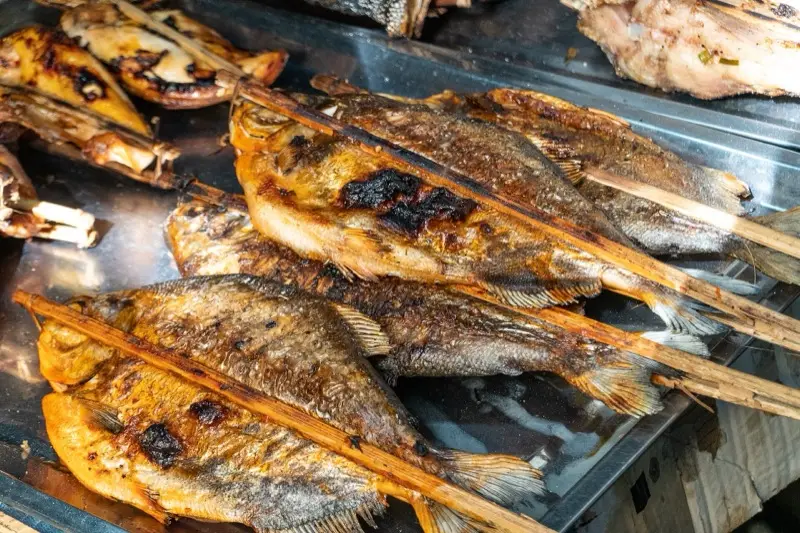
The stalls sell the usual snacks, fruit and drinks; beer has traditionally come by the bucket. Look out for num banh chok, the rice-noodle dish, which Kampot does in its own local style. Agree prices before you order: a few visitors have felt overcharged. For what else to eat around town, see our Kampot food guide.
Swimming safety
- Rocks are slippery. Wear sandals with grip, and climb in and out slowly.
- Currents change with the season. In the dry season the water is mostly gentle. In the wet season, and after heavy rain anywhere upstream, it can be strong. Stay in the shallow, calm sections.
- The dam can raise the water quickly. One visitor described a siren sounding before a release, after which the water rose to about twice its height within 20 minutes. If you hear a siren, or see the water rising or turning muddy, get out and move up the bank.
- Watch children yourself at all times.
- Dress like the locals. Cambodians usually swim in their clothes. A T-shirt and shorts over swimwear is the respectful choice, especially for women.
- Don't swim after drinking, and keep valuables with someone on the bank.
Our Is Kampot safe? guide covers river swimming around town as well.
The honest downsides
- They aren't really rapids. The dam has tamed them, and in the dry season the flow is gentle.
- Litter. After busy weekends, rubbish can pile up on the banks.
- Informal fees. Small amounts, but not always ticketed.
- Dogs hang around the food stalls. Don't feed them.
- There's not much to "see". Teuk Chhou is for lounging, not sightseeing.
With only one or two days in Kampot, we'd put the countryside, Kep and Bokor first; see how many days in Kampot. With a third day, or on a very hot afternoon, a couple of hours at Teuk Chhou is a lovely way to switch off.
Getting there and what to combine it with
Teuk Chhou is about 8–9 km north of Kampot, roughly 20–30 minutes by tuk-tuk. A scooter or even a bicycle works, but it's a hot ride, and parts of the road have been rough in the past. Two to three hours on site is plenty.
- Cave in the morning, swim after lunch. Phnom Chhngok cave temple is also north of town, though on a different road, so the hop between them isn't quick. Do its 200 steps while it's cool, then head to the rapids for lunch and a swim through the hottest hours.
- Not a quick add-on to the countryside loop. The salt fields, La Plantation and Secret Lake are east and south of town towards Kep, the opposite direction. Teuk Chhou works best on its own half day or as part of a custom day; see our Kampot countryside guide for those stops.
- End on the river. Back in town by late afternoon, you're in time for a sunset boat on the Kampot river.
Don't confuse Teuk Chhou with Secret Lake, the Khmer Rouge-era reservoir in the countryside towards Kep; that's a different place with a very different story (see Secret Lake history).
Ride with Seth
Teuk Chhou isn't on Seth's set tours, but it fits well into a custom day: for example Phnom Chhngok in the cool of the morning, then a long lunch and a swim at the rapids. Typical private half days around Kampot run about $20–25 per tuk-tuk. Seth was born in Kampot and has guided for 12 years; message him on WhatsApp and he'll confirm a fixed price for your plan.
FAQ
How much does it cost to visit Teuk Chhou rapids?
Expect an informal entry fee of about $1–2 per foreigner, plus about $1–2 for a hut or picnic platform. Food and drinks are extra; agree prices first.
How far is Teuk Chhou from Kampot?
About 8–9 km north of town, roughly 20–30 minutes by tuk-tuk.
Is it safe to swim at Teuk Chhou?
In calm, shallow sections in the dry season, generally yes. Take care on slippery rocks, avoid it after heavy rain, and get out if you hear a siren or see the water rising: a dam upstream can release water.
When is the best time to visit Teuk Chhou?
November to January is the best balance of water and calm. Go on a weekday for quiet, or at the weekend to see local families out in force.
Are there real rapids at Teuk Chhou?
Not really. A hydropower dam upstream regulates the river, so most of the year you'll find small cascades and pools rather than white water.