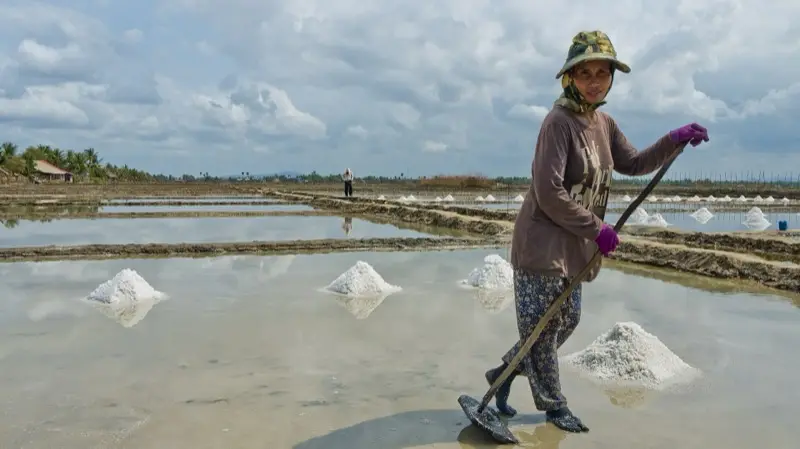
The Kampot salt fields are worked by hand, and the harvest runs roughly from January to April or May, peaking in March and April. Go in the late afternoon, when workers carry baskets of salt along the dykes in low light. From about May to November the pans are flooded or idle: still a quiet photo stop, but there's nothing to harvest. There's no fee, and the fields start a few kilometres out of town on the road to Kep.
On this page
Where the salt fields are
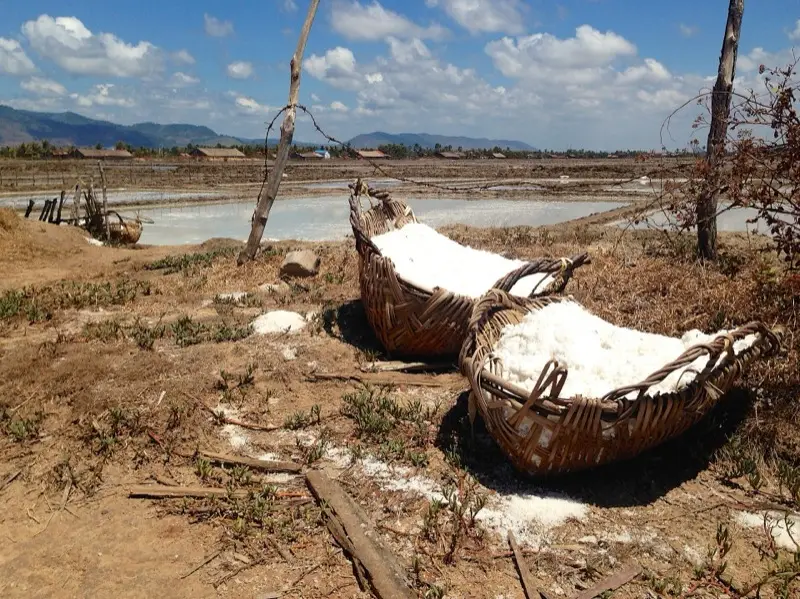
Leave Kampot on the road towards Kep, and after about 5 km the land flattens into a grid of shallow, rectangular pans, separated by narrow earth dykes and dotted with storage sheds. The fields carry on in patches towards the coast and into Kep province. Together, Kampot and Kep had about 4,750 hectares under salt in 2021, worked by around 200 families in the local salt association.
Because they sit right on the Kampot–Kep road, the salt fields are on almost every countryside and Kep itinerary. They take 15 to 30 minutes, depending on how much is happening and how many photos you want.
How Kampot salt is made
It's simple, slow and almost entirely manual:
- Seawater comes in. Water from the Gulf of Thailand is let or pumped into the system around December, through canals and holding pools.
- The sun does the work. The water moves into shallow, flat-bottomed pans. Sun and wind evaporate it until crystals form. A few days of heavy rain can set this back by ten days or more.
- Fleur de sel first. The most delicate crystals form a fragile crust on the surface and are skimmed off by hand before anything else.
- Raking. The rest of the salt is raked into small white piles across the pan.
- Carrying. Workers shovel it into bamboo baskets and carry them on a pole across the shoulders. A basket of wet salt weighs about 25 kg.
- Storage. The salt is tipped into sheds, where it waits to be collected and cleaned.
Most of the workers are women. Days start around 5am, break for lunch in the worst heat, then run until sundown. It is hard, hot work for little money: in early 2023, a 50 kg sack sold at the fields for about 25,000–28,000 riel, roughly $6–7. When the wet season comes, many of the same families switch to growing rice.
Output depends almost entirely on the weather. In a good dry year Kampot and Kep can produce 80,000 tonnes or more; in a wet one, a fraction of that. Cambodia's output, almost all of it from these two provinces, was about 175,000 tonnes in 2015 but only 33,000 in 2017, and in bad years Cambodia has to import salt to meet demand.
Harvest season by month
| Month | What's happening | Worth a stop? |
|---|---|---|
| December | Pans are prepared and seawater is let in | Some activity, little salt |
| January | Harvest usually starts, earlier in a dry year; a wet January can push it to February | Yes, if it has started |
| February | Harvest under way | Yes |
| March–April | Peak harvest: most pans worked, most salt piled up | Yes, the best months |
| May | Winding down as the rains arrive | Often, but it can end early |
| June–July | Only in a hot, dry year does the harvest stretch this far | Ask locally |
| August–November | Wet season: pans flooded or idle | As a photo stop only |
These are typical patterns, not fixed dates. The start depends on when the rain stops, and an early monsoon can end the season weeks ahead of time. If the salt is the main reason for your trip, a local driver will know whether the pans are being worked that week.
Best time of day
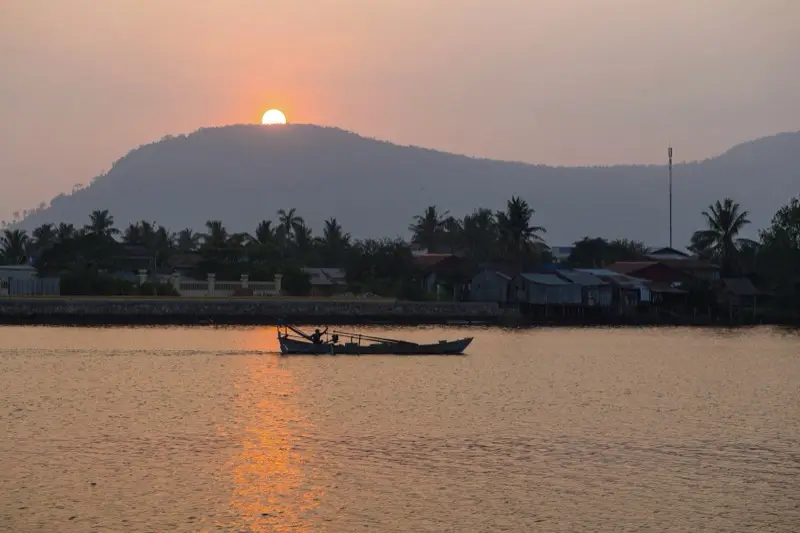
Late afternoon, roughly 4pm until sunset. That's when workers carry the day's salt to the sheds, the heat has eased and the light turns golden across the pans. It's the classic photo, and it's why a good countryside tour ends here rather than starting here.
Early morning is the other option. Work begins around 5am, the air is cooler and the light is soft. Midday is the weakest choice: harsh light, fierce heat, and many workers resting.
Where to stop
You don't need a ticket or a particular viewpoint: you simply stop where pans are being worked. A few tips:
- Pull right off the road. The Kampot–Kep road carries trucks and buses. Don't stand in the lane for a photo.
- Look for activity, not the first pan you see. On any given day some pans are being harvested and others are still evaporating.
- Combine it with the return leg. If you're going to Kep or doing the countryside loop, save the salt fields for the way back to Kampot so you hit the late light.
Photography etiquette
This is people's workplace, not an attraction. A little courtesy goes a long way:
- Ask before walking onto the dykes. They're narrow and they hold the pans together. Stepping into a pan can damage the salt.
- Ask before photographing anyone, especially close-ups. A smile and a gesture at your camera is enough; accept a "no".
- Don't get in the way. Someone carrying baskets of wet salt on a shoulder pole has right of way.
- Don't stage shots. Asking people to repeat a carry for your camera is asking them to do extra heavy work.
- Drones: ask first, and don't fly low over people.
- Don't hand out money or sweets. If someone has spent time with you and you want to say thanks, ask your guide how best to do it.
The salt fields in the wet season
From about May to November, we'll be straight with you: there's no harvest. The pans fill with rain or stand idle, and the workers are mostly in the rice fields. Photos online almost always show the harvest, so it's easy to arrive expecting one.
That said, the fields don't disappear. Flooded pans make a huge flat mirror for the sky, which on a stormy afternoon can be striking, and the storage sheds and dykes still give the place its shape. Treat it as a five-minute photo stop on the way to Kep's crab market or La Plantation, not a destination in itself. In the wet season, the countryside's best moments are elsewhere: green rice paddies, the full Secret Lake and flowing water on Bokor.
Ride with Seth
Seth was born in Kampot and has guided for 12 years. On his Kampot Countryside Tour, ask for the afternoon version in harvest season and ask him to keep the salt fields for last, when the light and the work are at their best. He also passes them on the Kampot & Kep Full Day. Message Seth for a fixed quote on WhatsApp; for the other stops, see our Kampot countryside guide.
FAQ
When is the salt harvest in Kampot?
Roughly January to April or May, peaking in March and April. A dry year can stretch it into June or July; early rains cut it short.
What is the best time of day to visit the salt fields?
Late afternoon, from about 4pm until sunset, when workers carry the salt to the sheds and the light is soft. Early morning is a good second choice.
Is there an entrance fee for the Kampot salt fields?
No. They're working fields beside the public road. Just ask before walking on the dykes or photographing people.
Are the salt fields worth visiting in the rainy season?
Only as a short photo stop. From about May to November the pans are flooded or idle and there's no harvest to watch.
How far are the salt fields from Kampot?
About 5 km from town on the road to Kep, so 10 to 15 minutes by tuk-tuk.