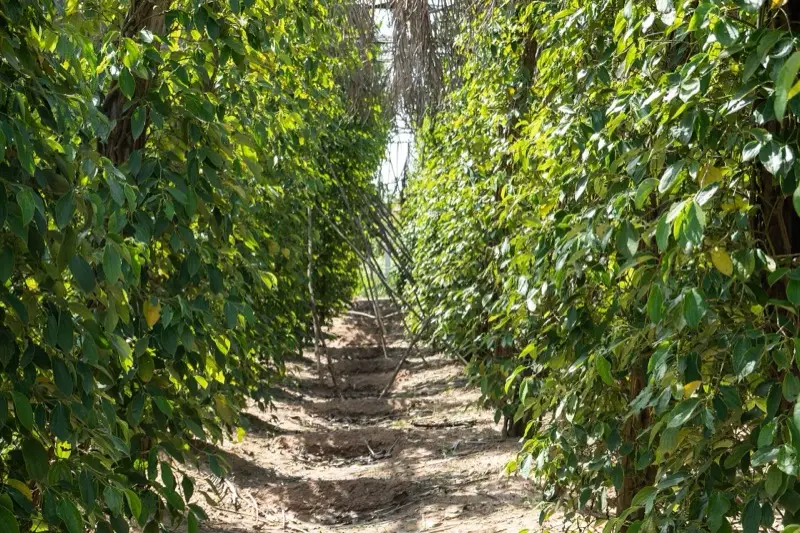
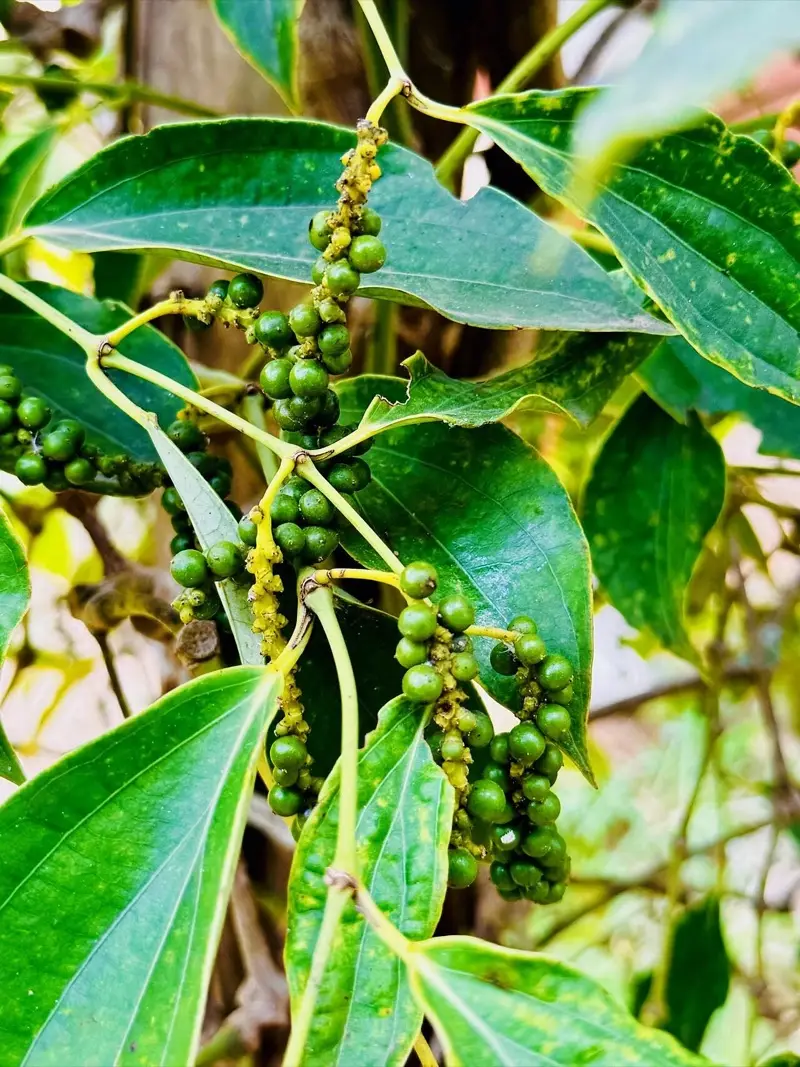
Kampot pepper is pepper grown under strict rules in a small area of Kampot and Kep provinces, protected as a geographical indication in Cambodia since 2010 and in the EU since February 2016. One plant gives four kinds: green (fresh berries), black (sun-dried green berries), red (fully ripe berries, dried) and white (ripe berries with the skin removed). To get the real thing, buy sealed, labelled bags with the PGI logo and a producer number, ideally at a farm. Dried and sealed, it's usually an easy souvenir to take home, but check your own country's rules first.
On this page
What makes pepper "Kampot pepper"
Botanically it's the same species as any black pepper. What makes it Kampot pepper is where and how it's grown, and the name is protected by law:
- Where: seven districts and towns in Kampot and Kep provinces.
- Which plants: two traditional local varieties, the small-leaved kamchay and the large-leaved lampong (also called belantoeung).
- How: the specification bans chemical fertilisers and pesticides. Berries are picked by hand, dried in the sun and sorted by hand, grain by grain, to minimum sizes.
- Who checks: the Kampot Pepper Promotion Association (KPPA), the producers' body, with an independent certifier. Only accredited members who follow the rules may sell pepper as "Kampot pepper".
- How much: the association has around 400 members, most of them smallholders, and together they have produced about 100 tonnes a year since 2019. That is tiny next to Cambodia's ordinary pepper crop.
Green, black, red and white: how each is made
All four come off the same vines. The difference is when the berries are picked and what happens next.
| Colour | How it's made | Taste | Use it for |
|---|---|---|---|
| Green | Unripe berries picked fresh on the stem. Eaten fresh in season, or preserved in salt or brine, or dried. | Fresh, herbal, gentle heat | Crab, seafood, stir-fries |
| Black | Mature green berries, picked as the stems begin to yellow, briefly scalded, then sun-dried for two to three days until dark and wrinkled. | Warm, aromatic, the all-rounder | Almost everything, especially red meat |
| Red | Only fully ripe red berries, picked or sorted by hand, then scalded and sun-dried. | Sweeter and fruitier, with a softer heat | Finishing dishes, salads, fruit, desserts |
| White | Ripe red berries soaked in water, the skin rubbed off, the cores washed and sun-dried. | Clean and sharp, without the fruitiness | Fish, light sauces, soups |
One detail matters for white pepper. Ordinary white pepper on supermarket shelves is often made by mechanically stripping black pepper. PGI Kampot white pepper must be made from ripe berries, which is part of why it costs more. Red is pricier than black for a similar reason: it needs berries picked at full ripeness.
Harvest: the main harvest runs from about January to the end of May, in several pickings as clusters ripen. Fresh green pepper comes first, from around December. That's when you'll see pepper drying on nets and mats at the farms.
A short history
- 13th century: the Chinese envoy Zhou Daguan mentioned pepper growing in Cambodia during his visit to the Angkorian court.
- From the 1870s: under the French protectorate, Chinese families, many from Hainan, set up the first large plantations around Kampot. In the early 1900s Cambodia was harvesting about 8,000 tonnes a year, much of it shipped to France.
- 1960s: around a million pepper poles still stood in Kampot, producing roughly 3,000 tonnes a year.
- 1970s–1990s: war and the Khmer Rouge years nearly ended pepper farming here. By the late 1990s only a few tonnes a year were harvested.
- 2000s: families who had kept old vines and know-how returned to their land. The producers' association was founded in 2009.
- 2 April 2010: Kampot pepper and Kampong Speu palm sugar became Cambodia's first registered geographical indications.
- February 2016: the EU registered "Poivre de Kampot" (Mrech Kampot) as a Protected Geographical Indication, the first for a Cambodian product.
- 2021: Kampot pepper became the first product registered under the Geneva Act of WIPO's Lisbon system for geographical indications.
The protection has paid off for farmers. WIPO reported that average farm-gate prices rose from about $7.50 a kilo before registration to about $22.70 ten years later.
How to spot real Kampot pepper
Because it sells for several times the price of ordinary pepper, there's a fake trade. In 2020 the association's president told NPR that pepper sold as Kampot pepper, mostly from Vietnam, was a real problem. Here's what to check:
- The label. Look for the geographical-indication logo with the name "Kampot pepper" alongside it. Packs sold in the EU often carry the EU's PGI symbol too.
- A producer or traceability number on the pack, identifying the farm.
- Sealed packaging. Vacuum-sealed or factory-sealed bags and tins, not a scoop from an open sack.
- The grains. PGI pepper is hand-sorted, so grains are even in size, with few broken pieces, stalks or dust.
- The price. If "Kampot pepper" is no dearer than ordinary pepper, it probably isn't Kampot pepper. As a guide, FAO figures put 2020 farm-gate prices at about $10 a kilo for black, $25 for red and $28 for white; shop prices are higher.
- Be wary of "Kampot-style" wording, unlabelled pepper in markets, and labels that only say "Cambodian pepper". These can be fine everyday pepper, but they aren't PGI Kampot pepper.
Where to buy it
- At a farm. The surest option, and you can taste before you buy. La Plantation has a shop at the farm (open daily 9am–6pm), and BoTree sells its own pepper too.
- Farm shops in Kampot town. BoTree has a shop on Old Market Street, handy if you have no time to go out to a farm.
- Markets. Fine for cooking pepper, but you can't check where loose pepper came from.
Buy whole peppercorns, not ground: they keep their aroma far longer. A small bag each of black, red and white makes a good tasting set, and gifts that pack flat.
Bringing it home
Customs and biosecurity rules depend on where you live, so treat this as general advice and check your own country's official customs or biosecurity website before you fly.
- Dried, sealed, labelled pepper is usually the easiest food souvenir: a processed, commercially packed product in personal quantities. Keep it in its original packaging with the label visible.
- Declare it where required. Australia, New Zealand and the United States, for example, ask you to declare food on arrival. Declaring costs nothing; failing to declare can mean confiscation or a fine.
- Fresh green pepper on the stem is the problem. It's fresh plant material. In the EU, for example, fresh fruit and vegetables from outside the EU need a plant-health certificate, which travellers almost never have. Enjoy it in Kampot.
- Green pepper in brine is a liquid, so put jars in checked luggage, not your hand luggage, and wrap them well.
At home, store pepper airtight and away from light, and grind it just before use. Add it towards the end of cooking: long heat dulls the aroma you paid for.
Ride with Seth
Seth's Kampot Countryside Tour includes La Plantation, where you walk the vines, see how the colours are made and taste them side by side before you buy. From October to March, when the farm asks for bookings, Seth can reserve your slot. He was born in Kampot and has guided for 12 years. Message him for a fixed quote on WhatsApp.
FAQ
What's the difference between black, red, white and green Kampot pepper?
Ripeness and processing. Green is the fresh unripe berry, black is the green berry sun-dried, red is the fully ripe berry dried, and white is the ripe berry with its skin removed.
What does PGI mean for Kampot pepper?
Protected Geographical Indication. Since 2016 in the EU, and since 2010 in Cambodia, only pepper grown in the defined area of Kampot and Kep provinces, under the producers' rules, can be sold as Kampot pepper.
How can I tell if Kampot pepper is real?
Buy sealed packs with the geographical-indication logo, the name "Kampot pepper" and a producer number, preferably from a farm or farm shop. Be wary of loose or very cheap pepper.
Can I bring Kampot pepper home?
Dried, sealed and labelled pepper is generally the easiest to travel with, but rules differ by country, so check your customs authority's website and declare food where required. Fresh green pepper is restricted in many countries.
When is Kampot pepper harvested?
From about January to May, in several pickings, with fresh green pepper from around December.