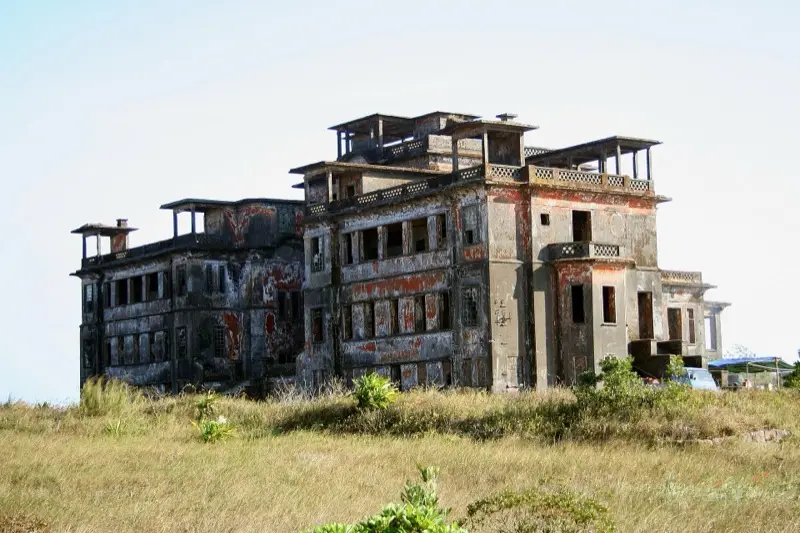
The French built Bokor hill station in the early 1920s as a cool retreat above Kampot, and its grand hotel, the Bokor Palace, opened in 1925. King Sisowath Monivong died on the mountain in 1941. The French left in the 1940s, King Sihanouk revived the resort in the 1960s, and around 1972 the Khmer Rouge took the plateau. After 1979 it became a battleground between the Khmer Rouge and the Vietnamese army. Since the 2010s a private developer has rebuilt the road and much of the plateau. Here's the story, with the dates sources agree on and the points where they don't.
On this page
Bokor at a glance
| When | What happened |
|---|---|
| Early 1920s | French build the road and the hill station |
| 14 February 1925 | The Bokor Palace hotel is inaugurated |
| 1928 | The Catholic church, begun in 1919, is blessed |
| 23 April 1941 | King Sisowath Monivong dies at Bokor |
| 1940s | The French abandon the station |
| 1962 | Sihanouk relaunches Bokor as a resort, with a casino |
| Around 1972 | The Khmer Rouge take over the mountain |
| 1979 | Months of fighting between the Khmer Rouge and the Vietnamese army |
| 1993 | The area is declared a national park |
| 2008–2012 | A 99-year lease to the Sokimex group, a new road, and a hotel-casino on the plateau |
| 2018 | The restored Bokor Palace reopens as a hotel |
| 2021 | Bokor becomes its own municipality |
Building a hill station (1920s)
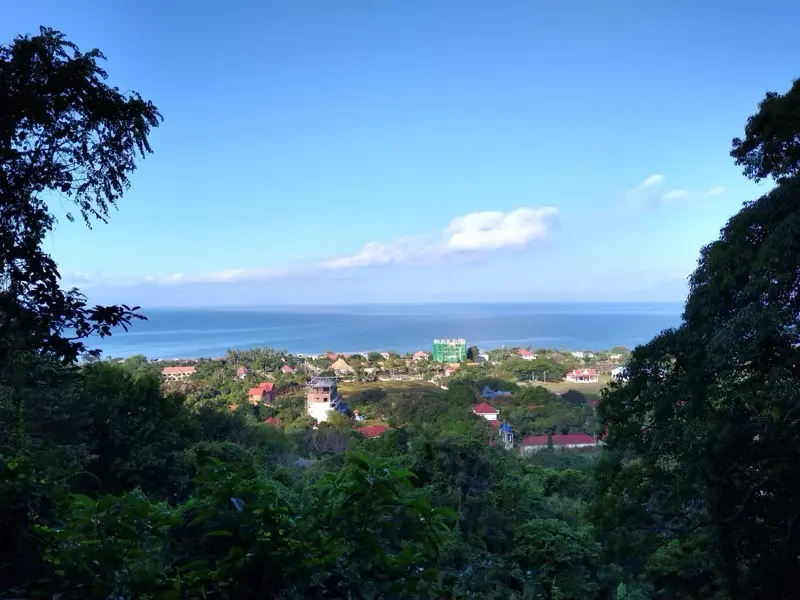
Like Dalat in Vietnam, Bokor was one of the "stations climatiques" the French built across Indochina so colonial officials could escape the lowland heat. The plateau, about 1,000 metres above Kampot, was cool, misty and had sweeping views over the Gulf of Thailand.
Getting there meant cutting a road up through dense rainforest. Thousands of Cambodian labourers did the work, and prisoners were among them. Conditions were brutal. The historian Michael Vickery gave a figure of about 900 deaths during the construction, many reportedly from malaria and other disease. It's the number most often cited, though it can't easily be checked against records today.
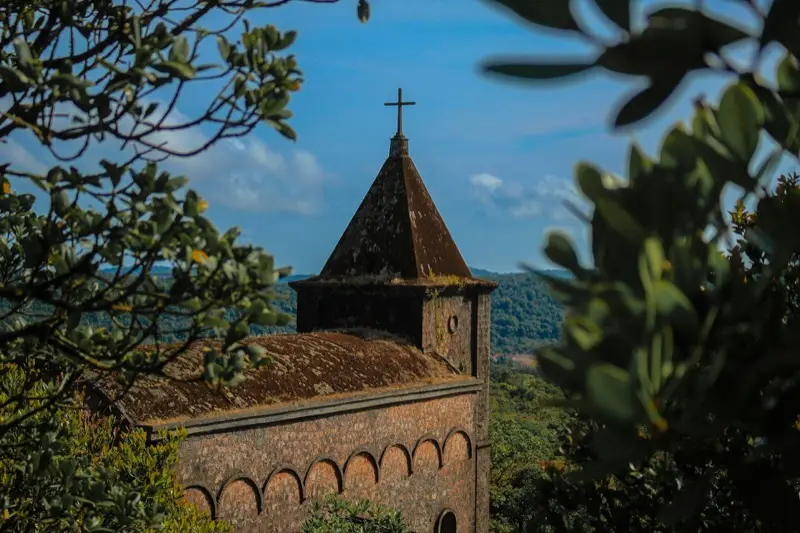
The centrepiece was the Bokor Palace, a grand hotel inaugurated on 14 February 1925. Around it stood villas, a post office and a stone Catholic church, begun in 1919 and blessed in March 1928.
Kings on the mountain
Bokor was a royal retreat as well as a colonial one. King Sisowath Monivong, who reigned from 1927, died at Bokor on 23 April 1941. The national park, officially Preah Monivong National Park, is named in his honour.
The Black Palace (Damnak Sla Khmao), a royal summer residence about 10 km before the old station, is usually dated to the 1930s and is best remembered as a residence of King Norodom Sihanouk. Today it is an empty shell with a fine view.
Abandonment and revival (1940s–1960s)
The French left Bokor in the 1940s. Sources differ on exactly when: some say during the Second World War, others in the late 1940s, when the Khmer Issarak independence movement made the remote mountain unsafe.
After independence, Bokor had a second life. In 1962, under Sihanouk's Sangkum government, it was relaunched as a resort, with new hotels and a casino. In 1969 Sihanouk shot his feature film Rose of Bokor on location here, with his wife Monique in the lead role.
War on the mountain (1970s–1990s)
After the 1970 coup that removed Sihanouk, Cambodia slid into civil war. The Khmer Rouge took control of Bokor around 1972, and the resort was abandoned for good.
When the Vietnamese army drove the Khmer Rouge from power in January 1979, Bokor became a front line. Reporting in the Phnom Penh Post describes about three months of fighting in early 1979, with Khmer Rouge fighters holed up in the church and Vietnamese troops in the hotel. Clashes on the mountain continued through the 1980s, and for years bullet and grenade marks on both buildings were plain to see.
Bokor remained a Khmer Rouge stronghold into the early 1990s. During the UN-supervised transition (UNTAC), French troops were based on the mountain, cleared mines and repaired the old road. In 1993 the area was declared a national park.
Many people died on this mountain, building it and fighting over it. You'll hear plenty of colourful legends up there too. We stick to what's documented, and we think the real history deserves a respectful visit.
Redevelopment (2008 to today)
In 2008 the government announced a 99-year lease of the plateau to the Sokimex group. A new sealed road up the mountain was essentially finished by the end of 2011, and the Thansur Bokor Highland Resort, a large hotel and casino, opened in 2012. The 29-metre Lok Yeay Mao statue on the way up was completed the same year.
The old Bokor Palace was restored by Sokha Hotels, part of the same group, keeping its colonial character, and reopened in February 2018 as a 36-room luxury hotel. In December 2017 the government handed the old church back to Cambodia's Catholic community, which has been raising funds since 2021 to restore it for its centenary in 2028.
The building hasn't stopped. In March 2021 Bokor became a municipality of its own, with a long-term plan to turn the plateau into a "smart" city by 2035. Work on a 108-metre Buddha statue began in January 2023, and a new road of about 61 km from the plateau down to National Road 4 has been built. There is still no cable car, only a feasibility study.
What you can see today
- Le Bokor Palace. The 1925 hotel, restored and operating. Only hotel guests can go inside; everyone else sees it from the outside.
- The Catholic church. Weathered stone on the edge of the plateau. Visitors have usually been able to step inside, though restoration work may limit access.
- The Black Palace. The empty royal residence on the way up.
- Wat Sampov Pram. A working pagoda named after five boat-shaped rocks. Remove your shoes and cover shoulders and knees.
- Lok Yeay Mao. The 29-metre statue of the revered guardian figure, with wide views on a clear day.
- The new Bokor. The Thansur resort and casino, housing projects and the giant Buddha under construction.
For the practical side, including the road, fog, what to wear and the fact that there's no entrance fee, read Bokor by tuk-tuk.
Where the sources disagree
- When the French left: during the Second World War or in the late 1940s.
- The Black Palace: most sources say the 1930s; others link it to Sihanouk's era.
- The Khmer Rouge takeover: dated anywhere from soon after 1970 to 1973. Around 1972 is the most common date.
- The construction death toll: the figure of about 900 traces back to one historian's account.
Ride with Seth
Seth's Bokor Mountain Day takes you up by tuk-tuk to the church, the Black Palace, Wat Sampov Pram and Le Bokor Palace from outside, with the history told along the way. He was born in Kampot, at the foot of the mountain, and has guided for 12 years. Message him for a fixed quote on WhatsApp.
FAQ
When was Bokor hill station built?
In the early 1920s, by the French colonial administration. The Bokor Palace hotel was inaugurated on 14 February 1925.
Did a king die at Bokor?
Yes. King Sisowath Monivong died at Bokor on 23 April 1941. The national park, Preah Monivong National Park, is named after him.
Why was Bokor abandoned?
Twice. The French left in the 1940s amid war and the independence struggle. After its 1960s revival, it was abandoned again around 1972, when the Khmer Rouge took over, and it was fought over until the 1990s.
Is the Bokor Palace still abandoned?
No. It was restored and reopened as a luxury hotel in 2018. Non-guests can see it from outside but can't go in.
Who owns Bokor now?
The land is state-owned, but much of the plateau was leased in 2008 for 99 years to the Sokimex group, which built the new road, the Thansur resort and the restored palace hotel.